Aggiornato il: 26 febbraio 2026
Per decenni, creare scene 3D realistiche ha significato costruire mesh, ottimizzare materiali e gestire pipeline di ricostruzione complessi. Oggi questo presupposto sta cambiando poiché il neural rendering sostituisce la struttura manuale con modelli appresi direttamente dalle immagini.
I Neural Radiance Fields (NeRF) ridefiniscono il modo in cui le scene vengono acquisite e rese, codificando l'intero ambiente come una funzione neurale continua. Senza mesh o nuvole di punti, NeRF consente la sintesi di viste fotorealistiche da dati sparsi, trasformando i flussi di lavoro moderni nella visione artificiale, la grafica e il spatial computing.
Questa guida spiega come funziona NeRF, come differisce dalle rappresentazioni 3D tradizionali e perché è importante nei flussi di lavoro professionali. Le sezioni seguenti descrivono i suoi principi fondamentali, il processo di rendering, le estensioni e le applicazioni pratiche in vari settori.
Definizione di Neural Radiance Field (NeRF)
Un Neural Radiance Field è un metodo per rappresentare una scena 3D come una funzione continua appresa da una rete neurale. Questa funzione predice il colore e la densità della luce in qualsiasi punto dello spazio in base alla posizione e alla direzione di visualizzazione.
In altre parole, NeRF memorizza una scena come un modello matematico anziché come mesh o nuvole di punti. Questo modello può essere interrogato da angoli di camera diversi per generare immagini realistiche della stessa scena.
Principi fondamentali dei Neural Radiance Fields

NeRF si basa su una rappresentazione neurale implicita, dove la geometria e l'apparenza della scena sono codificate all'interno di una rete neurale anziché essere memorizzate come mesh o voxel. Questo approccio tratta la scena come una funzione continua che può essere interrogata in qualsiasi posizione spaziale, consentendo un'interpolazione fluida e un rendering flessibile.
Il modello è generalmente implementato come un perceptron multistrato che accetta coordinate spaziali e direzione di visualizzazione come input. Da questi input, predice due proprietà fondamentali che descrivono come la scena appare e si comporta.
Densità volumetrica, che indica quanta materia u opacità esiste in un dato punto
Colore dipendente dalla vista, che descrive come la luce appare da una specifica direzione di visualizzazione
Insieme, questi output definiscono un campo di radianza continuo che combina struttura e apparenza in un'unica rappresentazione. La densità controlla la visibilità e l'occlusione, mentre il colore cattura l'apparenza direzionale appresa dalle immagini di input.
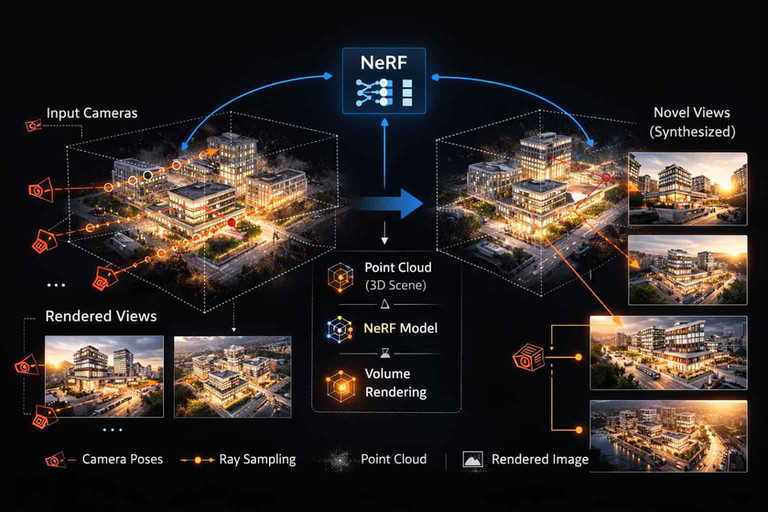
Durante il rendering, il campo di radianza viene campionato lungo i raggi della camera e integrato mediante il rendering volumetrico. Questo processo consente a NeRF di sintetizzare nuovi punti di vista con transizioni fluide e risultati visivi coerenti, anche per prospettive non presenti nei dati di addestramento.

Rendering volumetrico e campionamento dei raggi
NeRF genera immagini utilizzando il rendering volumetrico, un processo che simula come la luce si accumula lungo i raggi della camera. Per ogni pixel, un raggio viene lanciato dalla camera nella scena e campionato in più posizioni spaziali. In ogni punto di campionamento, il modello prevede i valori di colore e densità di volume.
La sintesi delle viste costruisce nuovi punti di vista valutando i raggi attraverso un campo di radianza appreso piuttosto che proiettando una geometria fissa. Ogni raggio integra i valori previsti lungo il suo percorso per determinare il colore finale del pixel. Questo processo consente la generazione fluida di viste inedite anche quando non esiste una rappresentazione esplicita della superficie.
A differenza del ray tracing tradizionale, che traccia i raggi rispetto a una geometria esplicita come i triangoli, la visibilità in NeRF viene gestita attraverso la densità accumulata lungo i raggi della camera.
Poiché la visibilità viene gestita attraverso la densità accumulata, questo metodo modella naturalmente l'occlusione e le transizioni morbide.
Inoltre, il path tracing estende il ray tracing attraverso la simulazione del trasporto luminoso multi-rimbalzo per l'illuminazione globale basata fisicamente. Il rendering volumetrico in NeRF si discosta dal rendering basato su superfici, operando su un campo di radianza continuo senza rappresentazioni geometriche esplicite.
In contrasto con la rasterizzazione, che dipende da triangoli predefiniti, il rendering volumetrico opera su un campo continuo e supporta l'aspetto dipendente dalla vista. Di conseguenza, NeRF può rappresentare effetti visivi complessi che sono difficili da esprimere con pipeline basate su mesh.
Rendering differenziabile e processo di apprendimento
NeRF si affida al rendering differenziabile, che consente l'addestramento attraverso l'ottimizzazione basata su gradienti. Gli errori tra le immagini renderizzate e le fotografie di riferimento vengono propagati all'indietro attraverso il processo di rendering.
L'addestramento utilizza tipicamente più immagini con pose della camera note o stimate, ottenute più comunemente tramite structure-from-motion o pipeline SLAM. Nei casi in cui le pose sono sconosciute o imprecise, alcune varianti di NeRF ottimizzano congiuntamente le pose della camera e la rappresentazione della scena durante l'addestramento.
Per migliorare la convergenza, NeRF applica il campionamento gerarchico, dove un modello grossolano identifica le aree importanti e un modello fine le affina.
Codifica Posizionale e Dettagli ad Alta Frequenza
Le reti neurali standard faticano a rappresentare dettagli spaziali fini. Per affrontare questa limitazione, NeRF utilizza la codifica posizionale, nota anche come caratteristiche di Fourier.
Questa tecnica mappa le coordinate di input in funzioni sinusoidali di dimensione superiore. Di conseguenza, il modello può rappresentare spigoli nitidi, texture dettagliate e variazioni spaziali rapide.
In pratica, la codifica posizionale è essenziale per ottenere ricostruzioni visivamente accurate.
Rappresentazione della Geometria e della Profondità in NeRF
NeRF non memorizza esplicitamente superfici come mesh o funzioni di distanza con segno. La geometria viene invece dedotta dal campo di densità appreso.
I valori di profondità possono essere stimati analizzando dove la densità accumulata raggiunge i picchi lungo un raggio. Questo fornisce indizi geometrici utili per attività successive. Tuttavia, questo processo non garantisce una profondità metricamente precisa.
Pertanto, la geometria estratta da NeRF dovrebbe essere considerata un'approssimazione piuttosto che un modello di riferimento.
Aspetto Dipendente dalla Vista e Comportamento dell'Illuminazione
La previsione del colore in NeRF dipende dalla direzione di visualizzazione, abilitando effetti di aspetto dipendente dalla vista. Ad esempio, le superfici possono apparire più luminose o più scure a seconda dell'angolo della fotocamera.
Tuttavia, NeRF non modella esplicitamente le sorgenti luminose o la riflettanza dei materiali. Codifica l'aspetto nelle condizioni di illuminazione presenti nelle immagini di training. Il vero relighting fisico richiede formulazioni estese.
Questa distinzione è importante quando si valuta NeRF per flussi di lavoro di editing dell'illuminazione o dei materiali.
Miglioramenti delle Prestazioni e Varianti Accelerate
La formulazione originale di NeRF è computazionalmente costosa. Molti approcci successivi si concentrano sul miglioramento dell'efficienza attraverso modifiche strutturali e algoritmiche.
Le strategie di ottimizzazione comuni includono:
Codifica hash multirisoluzione per la ricerca spaziale veloce
Rappresentazioni di scene fattorizzate o a basso rango
Strutture dati sparse per il campionamento efficiente
Pipeline di esecuzione ottimizzate su GPU
Esempi includono Instant NGP, TensoRF e PlenOctrees, che consentono un addestramento più rapido e il rendering quasi in tempo reale.
Varianti NeRF su Larga Scala
I modelli standard di Neural Radiance Field (NeRF) sono progettati principalmente per scene limitate, incentrate su oggetti o piccgli spazi interni, dove l'intero spazio 3D può essere rappresentato da una singola rete neurale. Tuttavia, questo presupposto viene meno quando si ha a che fare con ambienti su larga scala come isolati urbani, corridoi urbani o paesaggi esterni.
Queste scene introducono sfide relative al consumo di memoria, al tempo di addestramento, alla copertura delle viste, alla variazione di scala e alla coerenza spaziale a lungo raggio.
Per affrontare questi limiti, le varianti NeRF su larga scala estendono la formulazione originale suddividendo la scena globale in regioni spaziali più piccole e gestibili, ciascuna rappresentata dal proprio sottomodello neurale o rappresentazione strutturata. Questa decomposizione spaziale abilita l'addestramento e l'inferenza scalabili preservando i dettagli locali a grana fine.
Una strategia comune consiste nel dividere l'ambiente in blocchi spaziali, tile o celle, dove ogni blocco contiene un campo di radianza localizzato. Durante il rendering, i raggi vengono intersecati con le partizioni spaziali rilevanti e solo i sottosistemi corrispondenti vengono interrogati. Ciò riduce significativamente il sovraccarico computazionale e consente al sistema di scalare a scene che si estendono per chilometri anziché metri.
Mega-NeRF
Mega-NeRF è un approccio NeRF su larga scala di spicco progettato per la ricostruzione a scala urbana da collezioni massive di immagini. Invece di una singola rete monolitica, Mega-NeRF partiziona la scena in regioni spaziali e allena più sotto-reti NeRF, ciascuna responsabile di un sottoinsieme dell'ambiente.
Un sistema di coordinate globale assicura coerenza tra le partizioni, mentre le regioni sovrapposte aiutano a mantenere transizioni fluide tra blocchi adiacenti. Questo design consente un addestramento efficiente su dataset con milioni di immagini e supporta il rendering ad alta risoluzione di ambienti urbani.
Block-NeRF
Block-NeRF, introdotto da NVIDIA, estende ulteriormente questo concetto modellando interi isolati urbani utilizzando componenti neurali modulari. Ogni blocco viene addestrato indipendentemente utilizzando dati raccolti da veicoli (ad es. immagini in stile street-view). Block-NeRF integra:
partizionamento spaziale in blocchi,
embedding di apparenza condivisi per condizioni di illuminazione e meteo,
modellazione dell'apparenza dipendente dal punto di vista,
e coerenza temporale tra le acquisizioni.
Questo rende Block-NeRF particolarmente adatto per la creazione di gemelli digitali, la simulazione per la guida autonoma e la visualizzazione urbana su scala. Supporta cambiamenti di apparenza dinamici come illuminazione variabile, effetti stagionali e variazioni dell'ora del giorno.
Modelli NeRF Dinamici e Variabili nel Tempo
La formulazione originale di NeRF assume che la scena rimanga statica nel tempo. Per modellare il movimento e il cambiamento, i ricercatori hanno sviluppato approcci NeRF dinamici che estendono la rappresentazione introducendo il tempo come dimensione di input aggiuntiva.
Questi modelli sono progettati per catturare come una scena evolve, consentendo al campo di radianza di variare sia nello spazio che nel tempo. Di conseguenza, possono rappresentare:
Oggetti in movimento all'interno di una scena, come persone, veicoli o attrezzi, le cui posizioni cambiano nel tempo e devono essere rappresentate coerentemente tra i fotogrammi per preservare la continuità del movimento
Geometria deformabile o articolata, inclusi oggetti non rigidi o strutture con articolazioni, dove la forma cambia dinamicamente a causa del movimento, dell'interazione o dei vincoli fisici
Apparenza variabile nel tempo e pattern di movimento, dove le proprietà visive come ombreggiatura, texture o visibilità evolvono nel tempo a causa del movimento, della deformazione o del cambio delle condizioni di osservazione
Sequenze animate o temporalmente in evoluzione, in cui l'intera scena cambia nel tempo e deve essere modellata come un processo spatiotemporale coerente piuttosto che come un'istantanea statica
Tali approcci sono comunemente indicati come NeRF 4D o NeRF deformabili, riflettendo la loro capacità di modellare tre dimensioni spaziali più il tempo. Vengono utilizzati in applicazioni come simulazione, animazione e cattura delle prestazioni, dove rappresentare il movimento e la continuità temporale è essenziale.
Relazione con altre rappresentazioni neurali di scene
NeRF appartiene a una famiglia più ampia di rappresentazioni neurali di scene utilizzate nella visione artificiale e nella grafica. Gli approcci correlati includono funzioni di distanza con segno e reti di occupazione.
Le funzioni di distanza con segno si concentrano sulla geometria della superficie precisa. Le reti di occupazione modellano se lo spazio è dentro o fuori da un oggetto. NeRF enfatizza invece l'apparenza attraverso il rendering volumetrico.
I sistemi ibridi combinano sempre più frequentemente queste rappresentazioni per bilanciare l'accuratezza geometrica e la qualità visiva.
Applicazioni pratiche dei NeRF in diversi settori
I sistemi basati su NeRF supportano un'ampia gamma di workflow professionali consentendo la ricostruzione accurata e visivamente coerente della scena dai dati immagine. Rappresentando geometria e aspetto in un unico modello continuo, questi sistemi riducono la necessità di modellazione manuale migliorando al contempo la coerenza visiva tra i diversi punti di vista.
Questo cambiamento riflette come i workflow di rendering guidati dall'IA differiscono fondamentalmente dalle pipeline di rendering tradizionali, riducendo la dipendenza dalla modellazione manuale, dal mapping UV e dalla configurazione dei materiali.
Le aree di applicazione comuni includono:
Grafica computerizzata e animazione, dove NeRF supporta la ricostruzione realistica dell'ambiente e la sintesi di vista. Viene utilizzato per generare sfondi, set digitali ed effetti visivi che si integrano senza soluzione di continuità con i contenuti animati, contribuendo a mantenere la coerenza visiva nei movimenti e nelle inquadrature della fotocamera.
Imaging medico, dove le tecniche NeRF vengono esplorate per la ricostruzione di strutture anatomiche tridimensionali da scansioni bidimensionali. Queste ricostruzioni forniscono un contesto spaziale migliorato per la visualizzazione e l'analisi, sebbene tali applicazioni rimangono sperimentali e siano principalmente utilizzate per supporto visivo piuttosto che per la diagnosi.
Realtà virtuale e aumentata, dove NeRF consente la cattura immersiva di ambienti reali. Imparando rappresentazioni coerenti della scena, supporta la navigazione realistica e il rendering dipendente dalla vista, migliorando il realismo spaziale e l'immersione dell'utente.
Immagini satellitari e pianificazione urbana, dove i metodi basati su NeRF vengono esplorati per la ricostruzione di ampi ambienti esterni da immagini aeree o satellitari. Queste ricostruzioni supportano principalmente la visualizzazione, la comprensione spaziale e l'analisi urbana basata sulla ricerca, piuttosto che fungere da workflow di produzione standard.
IoT e gemelli digitali, dove i dati visivi raccolti da fotocamere e sensori vengono trasformati in modelli spaziali. NeRF consente la conversione dei flussi di immagini in rappresentazioni tridimensionali coerenti che supportano il monitoraggio, la simulazione e l'analisi spaziale all'interno dei sistemi di gemelli digitali.
Questi casi d'uso beneficiano di una qualità di rendering coerente, transizioni fluide tra punti di vista e una rappresentazione della scena flessibile che si adatta a diversi requisiti di produzione, simulazione e analisi.
Punti Chiave
NeRF rappresenta le scene in modo implicito anziché utilizzare mesh o nuvole di punti.
Le immagini vengono sintetizzate mediante rendering volumetrico integrando il colore e la densità lungo i raggi della fotocamera.
L'aspetto dipendente dalla vista consente risultati realistici in condizioni di illuminazione fissa
La geometria e la profondità sono dedotte dai campi di densità e devono essere trattate come approssimazioni.
Il rendering differenziabile consente l'apprendimento end-to-end dai dati immagine.
La codifica posizionale è essenziale per catturare dettagli ad alta frequenza e caratteristiche nitide.
Le varianti accelerate migliorano significativamente le prestazioni nell'addestramento e nel rendering.
Gli ambienti su larga scala richiedono partizionamento spaziale per una modellazione efficiente.
I NeRF dinamici estendono la rappresentazione al tempo e al movimento.
NeRF integra altre rappresentazioni neurali di scene in sistemi ibridi.
NeRF è applicato in più settori inclusi grafica, XR, visualizzazione urbana e gemelli digitali.
Domande frequenti
Le scene NeRF possono essere modificate dopo l'addestramento?
Le scene NeRF non sono direttamente modificabili come i modelli 3D tradizionali. La geometria e l'aspetto sono codificati implicitamente nei pesi della rete, il che significa che la rimozione di oggetti, i cambiamenti di materiale o le modifiche localizzate richiedono generalmente un nuovo addestramento o tecniche specializzate di editing NeRF piuttosto che strumenti 3D standard.
Gli output di NeRF possono essere convertiti in mesh o modelli CAD?
Non esiste una conversione diretta o senza perdite da NeRF a formati mesh o CAD. Sebbene sia possibile un'estrazione approssimativa della superficie dal campo di densità, la geometria risultante è spesso rumorosa e inadatta a flussi di lavoro ingegneristici o di fabbricazione.
NeRF sostituisce la fotogrammetria?
NeRF non sostituisce la fotogrammetria ma la complementa. La fotogrammetria si concentra sulla geometria esplicita e metricamente accurata, mentre NeRF privilegia la coerenza visiva e la sintesi di viste innovative ad alta qualità. I workflow ibridi sempre più spesso combinano entrambi gli approcci a seconda delle esigenze di lavoro.
Quante immagini sono necessarie per addestrare un NeRF affidabile?
Le prestazioni di NeRF dipendono fortemente dalla copertura delle viste. Anche se l'addestramento con un numero ridotto di immagini è possibile, i punti di vista limitati spesso causano artefatti visivi, geometria mancante o regioni sfocate. La riduzione dei requisiti di dati rimane un argomento di ricerca attivo.
Come gestisce NeRF le scene con oggetti in movimento?
NeRF standard presuppone una scena statica. Quando è presente movimento, gli elementi dinamici spesso risultano sfocati o ricostruiti in modo incoerente. Varianti NeRF dinamiche o deformabili specializzate sono necessarie per modellare il movimento, la deformazione o i cambiamenti temporali in modo affidabile.
Perché NeRF non è ampiamente utilizzato nei motori di gioco in tempo reale?
NeRF si basa sul rendering volumetrico anziché sulla rasterizzazione, il che lo rende computazionalmente costoso. Anche con varianti accelerate, NeRF manca di funzionalità chiave richieste dai motori di gioco, come la geometria esplicita, la gestione delle collisioni, la fisica deterministica e l'editabilità in tempo reale.
Perché le ricostruzioni NeRF sembrano realistiche ma mancano di misurazioni precise?
NeRF ottimizza la fedeltà visiva anziché l'accuratezza metrica. La profondità e la geometria sono dedotte dalle distribuzioni di densità e non sono garantite come precise in scala o fisicamente misurabili, il che limita l'uso diretto in contesti di ingegneria o costruzione.
In quale fase della produzione NeRF è più utile?
NeRF è più efficace durante la visualizzazione in fase iniziale, l'esplorazione, l'acquisizione di riferimenti e l'analisi sperimentale. Per asset di produzione finale, disegni tecnici o geometria pronta per la realizzazione, i workflow 3D tradizionali rimangono preferibili.