Updated on: 19 December 2025
In the early 20th century, architecture began to move away from ornament and historical references, turning instead toward clarity, efficiency, and everyday use. Out of this shift emerged Bauhaus architecture, a movement that embraced industrial materials, minimalist forms, and the belief that design should serve function. Developed in Germany between 1919 and 1933, Bauhaus architecture went on to shape not only buildings, but also furniture, housing estates, and modern approaches to urban planning.
This guide explains what Bauhaus architecture is, how it developed in Weimar, Dessau and Berlin, and which design principles define the style. It also looks at its impact on International Style modernism, social housing and global cities, then walks through iconic examples such as the Bauhaus Dessau Building, Haus am Horn, the Weissenhof Estate, Villa Tugendhat and Tel Aviv’s White City.
What Is Bauhaus Architecture?

Bauhaus architecture is a modernist approach to building design that grew out of the Bauhaus School founded by Walter Gropius in Weimar in 1919. The school aimed to unite art, craft, and technology in a single creative discipline, anticipating later discussions in generative architecture and system-based design thinking.
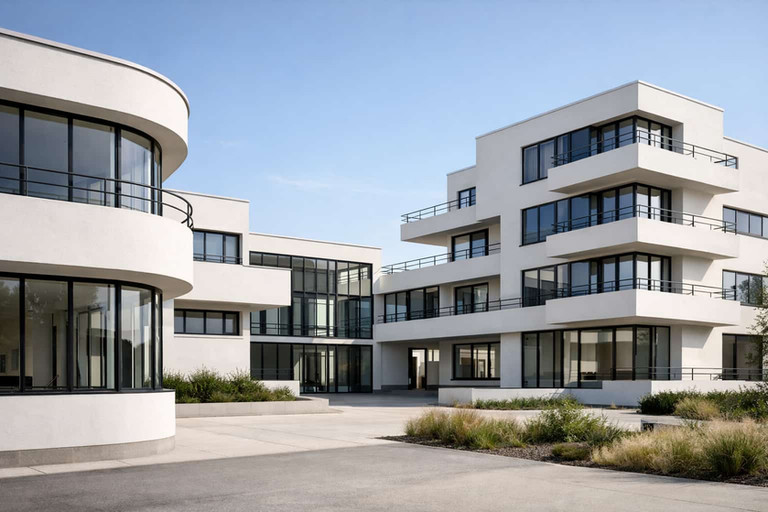
In architectural terms, the style is defined by:
Functional planning where the use of a space determines its form
Minimalist volumetric forms, often cubic or rectangular
Flat roofs and roof terraces
Asymmetrical compositions instead of classical symmetry
Open-plan interiors that encourage flexible use
Large glazed surfaces and steel-and-glass construction
White plastered façades with minimal ornament and limited color accents
The result is a clear, abstract aesthetic that treats buildings as rational machines for living, working and learning.
Historical Background of the Bauhaus Movement
Although Bauhaus architecture became one of the most influential modern movements, it did not emerge in isolation. It built upon earlier developments such as the Deutscher Werkbund and helped shape broader frameworks later described in architectural styles and modernist theory.
Its influence would later intersect with ideas articulated in The Five Points of Architecture, particularly through the work of Le Corbusier and the International Style.
From Weimar to Dessau and Berlin
The Bauhaus School was founded in Weimar in 1919 by Walter Gropius, with the aim of uniting art, craft, and industry. Its early years were shaped by workshop-based education that emphasized craftsmanship and artistic experimentation, influenced by the Deutscher Werkbund, Expressionism, and emerging ideas in industrial design.
Political pressure from conservative forces in Thuringia led to the closure of the Weimar Bauhaus in 1925. As a result, the school relocated to Dessau, where it was officially recognized as a state institution. The city commissioned Walter Gropius to design a new campus for the school.
The Bauhaus Dessau Building and the nearby Masters’ Houses, completed between 1925 and 1926, became iconic examples of European modernism.
In 1932, the Bauhaus moved again, this time to Berlin under the direction of Ludwig Mies van der Rohe. The rise of the National Socialist regime soon forced the school’s final closure in 1933.
After the closure, many Bauhaus teachers and students, including László Moholy-Nagy, Marcel Breuer, and Mies van der Rohe, emigrated abroad. Through their work in the United States, Palestine, and other parts of Europe, Bauhaus ideas continued to spread internationally and shape modern architecture and design.
Key Figures
Bauhaus architecture was shaped by several well-known architects, designers, and artists whose work influenced modern architecture and design worldwide.
Walter Gropius: Founding director and architect of the Bauhaus buildings in Weimar and Dessau.
Hannes Meyer: Second director who emphasized social housing and functional, cost-efficient design.
Ludwig Mies van der Rohe: Third director and later a leading figure of International Style modernism.
Marcel Breuer: Architect and furniture designer known for tubular steel chairs.
László Moholy-Nagy: Artist and theorist and later founder of the New Bauhaus in Chicago.
Lilly Reich: Architect and interior designer who collaborated closely with Mies van der Rohe and played a key role in exhibition design and modern interior architecture.
Gunta Stölzl: Textile designer and master of the Bauhaus weaving workshop who developed abstract, functional textile design integral to modern interiors.
Anni Albers: Textile designer and theorist whose work bridged craft, architecture, and industrial production and later influenced modern design education in the United States.
Marianne Brandt: Industrial designer known for metalwork, lighting, and household objects that embodied Bauhaus principles of functional and minimalist design.
Johannes Itten, Wassily Kandinsky, Paul Klee, Oskar Schlemmer: Artists and teachers who shaped the school’s visual language, theoretical foundations, and teaching methods.
Core Principles and Features of Bauhaus Design
Bauhaus architecture is defined by a set of interconnected principles that emphasize function, rational construction, and clarity of form. Rather than relying on historical styles, Bauhaus designers developed an architectural language rooted in spatial design, human movement, and everyday use.
Form Follows Function
Bauhaus architecture takes the modernist principle of form follows function seriously. Floor plans, structural systems, and façades are organized according to how spaces are used, rather than historical styles or decorative programs.
Minimalist, Geometric Forms
Buildings are composed of simple volumes and stripped of ornament, positioning Bauhaus as a foundational movement within minimalist architecture.
Industrial Materials and Construction
Steel, reinforced concrete, and large panes of glass are used to create open interiors and curtain walls. This industrial palette reflects the Bauhaus ambition to integrate architecture with mass production and contemporary manufacturing methods.
Early works such as the Fagus Factory foreshadowed later Bauhaus projects through their use of glass façades and functional planning.
Standardization and Modular Design
Bauhaus architects experimented with standardized building components, modular room units, and repetitive structural grids. The aim was to make construction faster, more efficient, and more affordable, particularly for social housing estates.
Light, Openness, and Transparency
Large glazed surfaces, corner windows, and ribbon windows bring natural light deep into interiors. Open-plan layouts connect living, working, and circulation areas, while balconies and roof terraces extend life outdoors.
The Masters’ Houses in Dessau exemplify this approach through cubic forms, flat roofs, and generous windows that blur the boundary between inside and outside.
How Bauhaus Buildings Are Experienced in Everyday Life?
Bauhaus architecture was not conceived as an abstract formal exercise but as a framework for everyday use. The experience of Bauhaus buildings is therefore closely connected to human scale, movement, and daily routines rather than monumental gestures or symbolic façades.
At the level of human scale, Bauhaus buildings tend to employ restrained proportions and clearly legible geometries. Flat façades, horizontal window bands, and simple volumetric compositions contribute to an environment that appears orderly and accessible at close range. This architectural clarity allows users to comprehend the building intuitively, without reliance on ornament or hierarchical symbolism.
The experience of approach and entry in Bauhaus architecture is typically direct and function-oriented. Entrances are often articulated through subtle shifts in volume, recessed planes, or material changes rather than decorative emphasis. Such strategies support clear orientation and reinforce the rational organization of movement.
Interior circulation is generally structured to promote spatial continuity and logical flow. Open-plan arrangements, visual connections between adjacent spaces, and generous glazing reduce physical and visual barriers. While individual experiences may vary, movement through Bauhaus buildings often unfolds through a sequence of interconnected spaces rather than isolated rooms.
The relationship between interior and exterior space plays an important role in the everyday perception of Bauhaus architecture. Large windows, corner glazing, balconies, and roof terraces enable daylight to shape interior environments while maintaining visual contact with the surroundings. This transparency supports a sense of openness and encourages an ongoing interaction between inside and outside.
In everyday use, Bauhaus buildings are commonly experienced as functional yet humane environments. Their architectural language prioritizes usability, light, and spatial clarity over expressive form. Rather than drawing attention to architecture as an object, Bauhaus design seeks to integrate the built environment seamlessly into daily life, supporting living, working, and learning through rational and accessible space.
Bauhaus Architecture Process and Design Approach
Although each Bauhaus architect had a personal style, their design process followed some shared steps.
1. Analyze Function and Users
Designs began with a careful study of how people would live, work or learn in the building. Hannes Meyer summarized this as focusing on people’s needs instead of luxury needs, especially for housing projects in estates like Dessau-Törten.
2. Organize Space Logically
Architects developed floor plans around circulation, light and specific activities. Many buildings use open-plan living areas and flexible partitions instead of rigid room sequences.
3. Choose Efficient Structural Systems
Reinforced concrete frames, steel skeletons and standardized components allowed long spans and flexible interior layouts. The structure was often expressed honestly on the façade, which underlined the unity of art and technology.
4. Refine the Envelope
Façades were treated as functional skins that regulate light, views and climate rather than as decorative surfaces. Curtain walls of glass, horizontal bands of windows and flat roofs support this logic.
5. Integrate Furniture and Objects
In many projects, Bauhaus architects also designed built-in furniture, lighting and textiles. Architecture, industrial design and craftsmanship were meant to form a single, coherent environment. This approach is visible in Haus am Horn and Villa Tugendhat, where interior elements and furniture are integral to the architectural concept.
Importance and Legacy in Modernist Architecture
Bauhaus architecture sits at the heart of twentieth-century modernism. Its influence appears in:
The International Style, which adopted flat roofs, white volumes and glass curtain walls in Europe and the United States
Post-war social housing and mass housing estates, which borrowed modular layouts and standardized construction techniques
Modern industrial design, from chairs and lamps to corporate identities, that follow functional and minimalist principles
The Bauhaus Dessau Building and related sites are recognized as key works of modern art and architecture that expressed a radical renewal of design.
Tel Aviv’s White City, with thousands of buildings in a local interpretation of the International Style, demonstrates how Bauhaus ideas migrated and were adapted to new climates and cultures.
The New Bauhaus in Chicago, founded in 1937 by Moholy-Nagy, carried Bauhaus pedagogy into American design education and helped shape human-centered and systemic design methods that are still influential today.
Bauhaus Principles in Contemporary Architecture and Digital Design
Although Bauhaus architecture emerged in the early 20th century, its core principles continue to influence contemporary architecture. Rather than being replicated as a visual or formal style, Bauhaus ideas persist primarily as a methodological and conceptual framework within modern design thinking.
In contemporary minimalist architecture, the Bauhaus emphasis on clarity of form, reduction of ornament, and functional planning remains evident. These principles are reflected in the widespread use of simple volumes, restrained material palettes, and open-plan interiors that prioritize flexibility and adaptability.
Many contemporary residential, cultural, and institutional buildings apply these ideas to support changing patterns of use over time. In this sense, Bauhaus thinking contributes to architectural approaches focused on long-term usability and functional resilience rather than stylistic uniformity.
The influence of Bauhaus principles can also be observed in large-scale technology campuses and corporate architecture, although not as direct stylistic imitation. Projects such as Apple Park or Google headquarters are not Bauhaus buildings in a historical sense, yet they reflect conceptual affinities with Bauhaus thinking.
These include rational spatial organization, emphasis on natural daylight, and the integration of architecture, interior design, furniture, and graphic systems into a cohesive built environment. Such parallels are best understood as conceptual rather than formal connections.
In digital and parametric design processes, Bauhaus principles remain relevant through their focus on problem-solving, systems thinking, and user-centered design. Contemporary computational tools extend the Bauhaus ambition to unite technology and design.
By supporting clarity, efficiency, and logical organization while allowing formal diversity, these tools reinforce Bauhaus ideas as a foundational approach to modern architectural thinking rather than a historical style.
Advantages of the Bauhaus Style
Clarity and Efficiency:
Functional planning often results in efficient circulation, logical spatial organization, and well-lit interiors.
Flexibility:
Open-plan layouts and modular structural grids allow spaces to adapt to changing functions over time.
Integration with Industry:
The use of standardized components supports prefabrication, mass production, and cost-efficient construction methods.
Aesthetic Coherence:
The integration of architecture, furniture, graphics, and typography creates unified and recognizable design environments.
Limitations of the Bauhaus Style
Climate Challenges:
Large glazed surfaces and flat roofs can lead to overheating, heat loss, and maintenance issues, particularly when local climate conditions are not fully considered.
Perceived Austerity:
Minimalist forms and restrained color palettes may be experienced as cold or impersonal by some users.
Heritage Constraints:
Many Bauhaus buildings are now protected monuments, which can restrict adaptation to contemporary technical, environmental, and accessibility standards.
Social Criticism:
Later critics have argued that some modernist housing estates influenced by Bauhaus principles were overly uniform and did not sufficiently address social and cultural diversity.
Common Misconceptions About Bauhaus Architecture
"Bauhaus architecture is purely functional and anti-art."
In reality the Bauhaus sought a synthesis of art and technology. The school integrated painting, sculpture, theatre, textiles and typography with architecture, and many buildings use color and composition in subtle ways.
"Everything Bauhaus is white and boxy."
White plaster façades are common, but the movement also explored color contrasts, exposed brick and varied materials. Interiors often used colored surfaces to articulate structure and space.
"Bauhaus started modern architecture."
The Bauhaus was a central player, but it built on earlier developments such as the Werkbund, the Fagus Factory, Dutch De Stijl and Russian Constructivism.
"Bauhaus equals International Style."
The Bauhaus informed the International Style, yet the term covers a wider range of architects and regional adaptations. Tel Aviv’s White City, for example, adapts these ideas to a Mediterranean climate through shading and balconies.
Iconic Bauhaus Buildings and Global Examples
Haus Am Horn, Weimar (1923)
Haus am Horn is the first and only building constructed by the Bauhaus in Weimar. Designed by Georg Muche, it was built as a model house for the 1923 Bauhaus exhibition and showcased integrated interior design, standardized components and a compact, rational plan organized around a central living room.
Key features:
Single-storey cubic volume with a flat roof
Ribbon of clerestory windows above the central space
Built-in furniture and coordinated textiles, ceramics and lighting
Bauhaus Dessau Building and Masters’ Houses (1925-1926)
The Bauhaus Dessau Building, designed by Gropius, embodies core principles of Bauhaus architecture. It is a complex of functionally distinct wings for workshops, classrooms, studios and administration, with a dramatic glass curtain wall on the workshop block.
Characteristics:
Reinforced concrete frame with non-loadbearing glass curtain walls
Flat roofs and bridge-like volumes connecting different wings
No single front façade, reflecting the equality of functions
Nearby, the Masters’ Houses provided residences for Bauhaus masters such as Gropius, Kandinsky and Klee. They use cubic forms, flat roofs, white surfaces and large windows to model modern living.
Dessau-Törten Housing Estate and Arcade Houses
The Dessau-Törten estate and later arcade houses were experimental social housing projects. They used standardized terraced houses and compact flats to address the housing shortage of the Weimar era, combining small living spaces with generous gardens and efficient construction.
Fagus Factory, Alfeld (1911-1913)
Although predating the Bauhaus School, the Fagus Factory by Gropius and Adolf Meyer is often cited as a proto-Bauhaus building. Its glass corners, exposed structure and emphasis on light and function anticipate later Bauhaus industrial architecture.
Weissenhof Estate, Stuttgart (1927)
The Weissenhofsiedlung was a Werkbund exhibition of model housing organized under the direction of Mies van der Rohe. Seventeen architects, including Gropius and Le Corbusier, designed 21 buildings that showcased modern construction, flat roofs and open plans. The estate played a major role in defining early modern architecture and mass housing typologies.
Villa Tugendhat, Brno (1928-1930)
Villa Tugendhat, designed by Mies van der Rohe and Lilly Reich, is a landmark of residential modernism. Built for Fritz and Greta Tugendhat, the reinforced-concrete villa features a free-flowing plan, luxurious materials and a glass wall that opens the main living space to the garden.
While not a Bauhaus school project, it translates Bauhaus and International Style ideas into high-end domestic architecture.
Tel Aviv’s White City (1930s)
In the 1930s, German and Central European architects trained in modernist and Bauhaus circles designed thousands of buildings in Tel Aviv. This White City contains a large concentration of structures in a variant of the International Style and is an important example of early twentieth-century modern town planning.
Local adaptations include:
Deep balconies and pilotis for shaded outdoor living
Light-colored plaster to reflect sun
Orientation strategies that optimize natural ventilation
The New Bauhaus, Chicago (From 1937)
The New Bauhaus, founded by László Moholy-Nagy in Chicago in 1937, did not focus only on buildings. It extended Bauhaus principles to photography, product design and visual communication, and later evolved into the Institute of Design at Illinois Tech.
Key Takeaways
Bauhaus architecture emerged from a radical educational project that sought to unite art, craft, and technology, redefining the role of architecture in modern society.
Active between 1919 and 1933, the Bauhaus developed across Weimar, Dessau, and Berlin, with each phase contributing differently to its architectural, social, and pedagogical ambitions.
The architectural language of Bauhaus is characterized by functional planning, minimalist geometric forms, industrial materials, flat roofs, and large glazed surfaces, prioritizing use over ornament.
Bauhaus architecture extended beyond buildings to include furniture, graphics, interiors, and urban housing, promoting a holistic approach to design.
Key figures such as Walter Gropius, Hannes Meyer, and Ludwig Mies van der Rohe shaped the movement’s direction, from experimental craft-based work to socially oriented housing and International Style modernism.
Through emigration after 1933, Bauhaus ideas spread globally, influencing International Style architecture, social housing, and design education, particularly in the United States and Tel Aviv’s White City.
While Bauhaus architecture offered clarity, efficiency, and adaptability, it also faced climatic, social, and aesthetic criticisms, highlighting the limits of universal modernist solutions.
Despite its relatively short lifespan, the Bauhaus left a lasting legacy, shaping the foundations of modern architecture and continuing to inform contemporary discussions on function, technology, and human-centered design.
Frequently Asked Questions
How is Bauhaus architecture different from other modernist movements like De Stijl or Constructivism?
While Bauhaus architecture shares modernism’s rejection of ornament, it differs by combining architecture with a broader educational and design system. Unlike De Stijl’s strict abstraction or Constructivism’s political radicalism, Bauhaus emphasized practical production, interdisciplinary collaboration, and everyday use.
Did the Bauhaus develop a single, unified architectural style?
No. Bauhaus architecture does not represent a single, unified architectural style. Instead, it evolved over time and encompassed multiple architectural styles, reflecting the ideas of different directors and teachers from early expressionist influences to functionalism and later International Style modernism.
Why are there relatively few buildings designed directly by the Bauhaus School itself?
The Bauhaus was primarily an educational institution rather than a conventional architectural office. Many ideas were tested through teaching, prototypes, exhibitions, and housing experiments rather than large-scale building commissions.
How did Bauhaus ideas influence architecture after World War II?
After 1933, former Bauhaus architects and designers played key roles in post-war reconstruction, modern university campuses, corporate buildings, and mass housing projects, particularly in the United States and Europe.
Is Bauhaus architecture sustainable by today’s standards?
Bauhaus buildings were not designed with contemporary sustainability criteria in mind. However, their emphasis on daylight, compact planning, and efficient use of materials aligns with some modern sustainable design principles, even though technical performance often requires upgrading.
Why is Bauhaus architecture still taught in architecture schools today?
Bauhaus architecture remains influential because it established foundational ideas about functional design, interdisciplinary education, and the relationship between technology and society, which continue to shape architectural pedagogy worldwide.
Can Bauhaus principles be adapted to contemporary digital and parametric design?
Yes. While the formal language may differ, Bauhaus principles such as rational problem-solving, user-focused design, and integration of technology are highly compatible with digital design tools and contemporary architectural workflows.