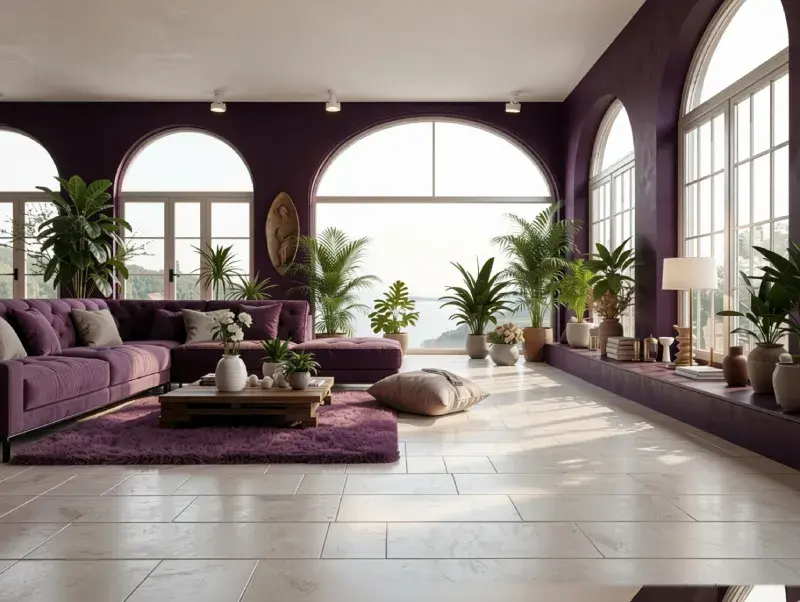
Plum Botanical Living Room
Wellness nature
Living room
•
Plum
Deep plum living room, velvet tufted sectional, arched windows, tropical plants, marble floor, sea view, purple shag rug, wellness interior
Where the plum wellness nature living room sits in interior design
Wellness nature interiors grew out of biophilic design thinking and spa architecture. The style relies on daylight, living plants, natural stone and tactile textiles rather than decorative complexity. What makes this living room unusual is the palette. Instead of the sand and off-white tones normally attached to wellness interiors, the walls are drenched in deep plum, and the restorative content comes from foliage, marble and a sea horizon.
Plum without the glamour reading
Purple velvet usually signals jewel-tone maximalism. This room avoids that reading. The tufting is shallow and flat, there is no gilt, no lacquer and no high-gloss trim. The plum wall finish looks matte and mineral, closer to clay paint or fine plaster than to enamel. Colour is used as a light absorber, softening the strong reflected glare from the sea, which is a functional decision rather than a stylistic flourish.
Materials and surfaces
The material logic follows a simple rule: hard and cool below, soft and warm at body height, living material at the perimeter.
Polished marble tiling in large format runs across the whole floor plate. Pale grey veining keeps the pattern quiet, and the reflectivity carries daylight deep into the plan.
Cotton or mohair-pile velvet covers the sectional. The pile catches light differently on each cushion face, which is why the sofa reads as several shades of plum at once.
A high-pile shag rug in a lighter mauve defines the seating zone. Beyond comfort, it absorbs the reverberation that hard stone and glass would otherwise produce.
Reclaimed timber forms the low coffee table, built from thick slats with visible grain and joints. It supplies the only rough texture in the room.
Unglazed ceramic and stone planters in chalk, grey and clay tones separate the green mass from the purple wall.
Foliage as a finish: monstera, kentia and areca palms, dracaena and small succulents. The plants are treated as a material layer, not as decoration.
Spatial and architectural character
The room is organised around a repeating arched window, with semicircular heads and radial glazing bars in white-painted timber. The arches appear on two walls, which turns the perimeter into a rhythmic colonnade of light. Between them, the plum wall reads as solid mass, so the openings feel cut rather than applied.
A low plum-upholstered banquette runs along the window wall at sill height. It works as bench seating, plant stand and shelf for books and ceramics, and it keeps the sightline to the sea uninterrupted. The sectional sits well off the wall in an L configuration facing the view, with a floor cushion completing the low seating group. Every horizontal surface stays under one metre, so the arches and the sky remain the tallest elements in the composition.
The ceiling is flat and white with small surface-mounted spots. Artificial light is deliberately understated, since the daylight from the arches carries the room. A single sculptural wall relief in carved stone or terracotta provides the only figurative element on the plum plaster.
How the style is interpreted today
Three current tendencies converge in this living room. Colour drenching pushes a saturated tone across walls and upholstery, so the shell reads as a single mass. The arch revival returns curved openings to contemporary residential architecture after decades of rectangular glazing. Plant density has increased, with grouped pots of varying height replacing the single statement tree.
Alongside these, wellness interiors now accept dark colour. Earlier biophilic schemes assumed pale walls. Current practice treats deep plum, forest green and clay brown as calming, particularly in rooms with strong coastal or south-facing light where white surfaces cause glare.
When and where the style is chosen
This approach suits rooms with generous glazing and a view worth framing. Coastal villas, hillside houses and top-floor apartments give it the light and horizon it needs. It is also chosen when a client wants atmosphere without ornament, or when a large open plan needs a defined, quiet zone.
Use areas where it performs well:
Living rooms and lounges with long window walls, where colour balances the light
Reading and meditation corners, using the low banquette and floor cushions
Hotel and spa lounges that need acoustic softness under stone floors
Bedrooms and sitting rooms in warm climates, where marble helps thermally
Winter gardens and sunrooms, where plant density is already part of the programme
Prompt examples
Wellness nature living room with deep plum plastered walls, three tall arched windows framing a calm sea, tufted plum velvet sectional, honed white marble floor, grouped kentia and monstera plants in unglazed ceramic pots, morning light, wide eye-level view
Corner detail of a biophilic living room, low plum upholstered window banquette under an arched opening, stacked books, stone bowls and a linen lampshade, palm fronds in the foreground, soft afternoon backlight, shallow depth of field
Plum wellness interior at dusk, warm lamplight replacing daylight, velvet sectional and mauve shag rug in shadow, reclaimed timber coffee table with ceramics, silhouetted plants against the arched glazing, low camera angle
Open plan coastal living room in deep plum, marble floor extending to a terrace door, floor cushions and a carved stone wall relief, dense tropical planting along the window wall, overcast diffuse light, symmetrical composition