Updated on: 30 October 2026
A neural radiance field (NeRF) is a way to turn a set of ordinary photos of a real scene into a 3D scene you can view from new angles. A neural network learns, from photos taken at known camera positions, the color and density of every point in space, and volume rendering then draws views the camera never took. NeRF was introduced by Mildenhall, Srinivasan, Tancik, Barron, Ramamoorthi and Ng in their ECCV 2020 paper and is one of the best-known methods of neural rendering.
Since 2023 a second method, 3D Gaussian Splatting, stores the scene as explicit 3D Gaussians instead of a network and displays it in real time; many capture tools now offer it, and the two are often grouped together as radiance fields. This guide explains how NeRF works in four steps, how it compares with Gaussian splatting, photogrammetry and laser scanning, where architects meet both, and which tools create them as of October 2026.
How NeRF Works in Four Steps
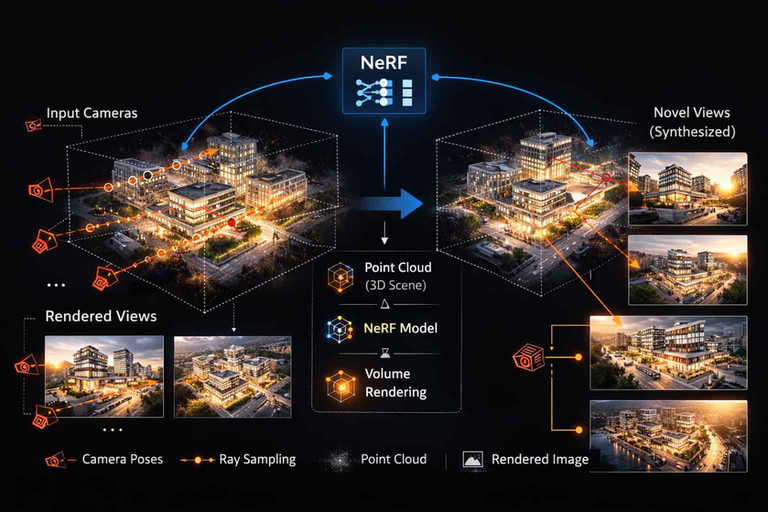
The original paper describes NeRF as a fully connected network that takes "a single continuous 5D coordinate", a position and a viewing direction, and returns volume density and view-dependent color; images are made from it with classic volume rendering. In practice that comes down to four steps.
Step 1: Photos and Camera Poses
Training starts from a set of photos of the scene taken from many positions, plus each camera's position and orientation (its pose). For real scenes the original NeRF estimated the poses with structure-from-motion software (COLMAP); SLAM systems are another source, and some later variants refine the poses during training. Coverage matters more than the number of photos: parts of the scene seen from few angles come out blurred or missing.
Step 2: Rays and Sample Points
For each pixel, NeRF casts a ray from the camera into the scene and picks sample points along it. The original method runs a coarse network first to find where the content is, then places more samples there for a fine network. This hierarchical sampling spends the computation on surfaces instead of empty air.
Step 3: The Network Predicts Density and Color
Each sample's position (x, y, z) and the ray's viewing direction go into a multilayer perceptron (MLP). It returns two values: volume density, how much matter or opacity is at that point, and view-dependent color, which lets reflections and highlights change as the camera moves. Before entering the network, the coordinates pass through a positional encoding, sines and cosines at several frequencies, a form of Fourier feature mapping that lets the network learn sharp edges and fine texture.
Step 4: Volume Rendering and Training
The colors of the samples along a ray are blended, weighted by their density, into one pixel color. Unlike ray tracing, which tests rays against explicit surfaces such as triangles, NeRF handles visibility through the density accumulated along the ray, so occlusion and soft edges come naturally. Because this volume rendering step is differentiable, the difference between each rendered pixel and the real photo is passed back into the network's weights by gradient descent; repeated over many rays, the network learns the scene and can then render views from new camera positions.
NeRF does not simulate light the way path tracing computes global illumination: it reproduces the light that was in the photos.
Geometry, Depth and Lighting in a NeRF
NeRF stores no surfaces: no mesh, no point cloud, no signed distance function. Geometry is implied by the learned density field, and a depth value can be estimated where the density along a ray peaks. That gives useful cues, but it is not metrically precise, so geometry taken from a NeRF is an approximation, not a survey.
Lighting is baked in. NeRF does not model light sources or material reflectance; it reproduces the scene under the light of the training photos, with highlights that change with the viewing direction. Relighting a scene or changing a material needs extended methods, which matters if you want to use a capture for lighting or material studies.
Faster NeRFs: Instant NGP, TensoRF and PlenOctrees
The original NeRF is computationally expensive: it queries the network at every sample of every ray, both in training and for every new view. Three methods show how that was cut down:
Instant NGP (Müller, Evans, Schied and Keller, NVIDIA, SIGGRAPH 2022) pairs a small network with a multiresolution hash encoding; its paper reports training "in a matter of seconds" and rendering "in tens of milliseconds" at 1920×1080.
TensoRF (ECCV 2022) factorizes the radiance field into compact tensor components, for faster reconstruction and smaller models.
PlenOctrees (Yu, Li, Tancik, Li, Ng and Kanazawa, ICCV 2021) converts a trained NeRF into an octree for real-time display: above 150 frames per second at 800×800, which the authors put at over 3000 times faster than conventional NeRFs.
The same push for speed led to 3D Gaussian Splatting.
NeRF vs Gaussian Splatting
3D Gaussian Splatting (3DGS; Kerbl, Kopanas, Leimkühler and Drettakis, SIGGRAPH 2023) learns a scene from the same input as NeRF, photos with camera poses, but stores it differently. It starts "from sparse points produced during camera calibration", turns them into 3D Gaussians, small soft ellipsoids with a position, a shape (anisotropic covariance), an opacity and a color, and adjusts them until the rendered views match the photos. For where both methods sit among other rendering algorithms, from rasterization to diffusion models, see our overview.
| NeRF | 3D Gaussian Splatting |
|---|---|---|
Introduced | Mildenhall et al., ECCV 2020 | Kerbl et al., SIGGRAPH 2023 |
How the scene is stored | Implicitly, in the weights of a neural network | Explicitly, as a large set of 3D Gaussians |
Input | Photos with known camera poses | Photos with known camera poses and the sparse points from camera calibration |
How a view is drawn | Volume rendering: the network is queried at many samples along every ray | The Gaussians are projected onto the screen (splatted) by a visibility-aware rasterizer |
Display speed | Original: far from real time; Instant NGP: tens of milliseconds per 1920×1080 view | Real time: 100 fps or more at 1080p, according to the paper |
Editing | Hard: changes need retraining or special editing methods | Easier: the Gaussians are explicit and can be selected, moved or deleted |
Exchange format | Network weights, read by the software that trained them | A glTF extension, KHR_gaussian_splatting, released as a candidate on 3 February 2026 |
Measured geometry | No: geometry is inferred from density | No: the Gaussians approximate surfaces but are not a survey |
Neural network | Yes | Not in the original method |
Why Is Gaussian Splatting Faster Than NeRF?
NeRF runs its network at many points along every ray to color each pixel. Gaussian splatting has no network to evaluate per pixel: the scene is already a list of Gaussians with their colors, and a rasterizer built for them projects and blends them on the GPU. That is why the original paper reaches 100 frames per second or more at 1080p, where the original NeRF was far from real time.
Is Gaussian Splatting Accurate?
Visually, it can come very close to the photos from the viewpoints that were captured, and it gets weaker away from them. Geometrically, it is not a survey: the Gaussians approximate the surfaces, and the capture has no reliable real-world scale until it is tied to measured points. The same holds for NeRF.
Do NeRF and Gaussian Splatting Need LiDAR?
No. Both methods need only photos or video frames and the camera poses computed from them. LiDAR or survey points can be added to a capture to fix its scale or help align it, but neither method requires them.
Is Gaussian Splatting Considered AI?
In the broad sense of machine learning, yes: the Gaussians are optimized by gradient descent to match the photos, much as a network is trained. But the original 3DGS uses no neural network, while NeRF is one. Neither method designs anything: both reproduce a place that was photographed.
NeRF, Photogrammetry and Laser Scanning
Photogrammetry also starts from overlapping photos, but it produces explicit geometry, a point cloud and a textured mesh that can be measured once the model is scaled. Laser scanning measures distances directly and produces the point clouds that existing-conditions surveys and scan-to-BIM work rely on. NeRF and Gaussian splats aim at what a place looks like from any angle, including glass and reflections; their geometry is inferred and its scale cannot be relied on, which limits their direct use in engineering or construction.
Is Gaussian Splatting Better Than Photogrammetry?
Not better, different. Splats and NeRFs are built to reproduce what the photos show, including effects that change with the viewing angle; photogrammetry and laser scanning are built to give geometry you can measure, dimension and bring into CAD or BIM. The methods can be combined: a scan for the measurements, a splat or a NeRF for the look.
When the goal is a plan you can dimension, a capture is only a reference. Take the key lengths from a survey or measure them on site, then draw the plan in Floor Plan Maker: you draw walls, doors, windows and rooms in a desktop browser, calibrate the scale from one known length, add dimension lines and see each room's area while wall lengths and furniture dimensions appear as you draw, like in a CAD program, view the plan in 3D or walk through it, and export DXF, SVG, PDF, PNG, GLB or OBJ. Drawing, editing, the 3D view and the exports are free.
Large-Scale NeRFs: Mega-NeRF and Block-NeRF
The original NeRF suits bounded scenes, an object or a room that one network can hold. A campus or a city block strains a single network in memory, training time and view coverage, so large-scale methods split the scene into regions, each with its own sub-model, and query only the regions a ray passes through.
Mega-NeRF
Mega-NeRF (Turki, Ramanan and Satyanarayanan, Carnegie Mellon University, CVPR 2022) models buildings or several city blocks from thousands of images collected mainly by drones. It clusters the training pixels by geometry into sub-modules that train in parallel. Its authors report 3× faster training and 12 % higher PSNR (an image quality measure) than conventional NeRF methods, and rendering 40× faster for interactive fly-throughs.
Block-NeRF
Block-NeRF is Waymo research (Tancik, Casser, Yan, Pradhan, Mildenhall, Srinivasan, Barron and Kretzschmar, CVPR 2022). It renders an entire neighborhood of San Francisco, built from 2.8 million images captured by vehicles over months under different environmental conditions. Each block is trained separately; per-image appearance embeddings, learned pose refinement and controllable exposure handle the changing light and weather, and the appearance of neighboring blocks is aligned so they join smoothly. Waymo files it under perception and simulation research.
Dynamic NeRFs: Scenes That Move
The original NeRF assumes the scene does not change: a person walking through the capture comes out blurred or broken. Dynamic, or deformable, NeRFs add time as an input, which is why they are also called 4D NeRFs, so the field can represent:
moving objects such as people and vehicles
deforming or articulated shapes
appearance that changes over a sequence
They are used mainly in research, animation and performance capture. For a building or an interior, the practical answer is to capture it while nothing moves and the light stays steady.
NeRF and Other Neural Scene Representations
NeRF belongs to a family of neural scene representations. Signed distance functions describe the distance to the nearest surface and suit precise geometry; occupancy networks model whether a point is inside or outside an object; NeRF models appearance through volume rendering. Hybrid methods combine them to balance geometric accuracy and visual quality.
NeRF and Gaussian Splats in Architecture and AEC
In architecture, engineering and construction (AEC), radiance fields capture what already exists and show it from any angle. Examples as of October 2026:
Maps. Google announced Immersive View for Google Maps on 8 February 2023, using NeRF to turn ordinary pictures into 3D representations, first in London, Los Angeles, New York, San Francisco and Tokyo; in June 2023 Google Research explained how it reconstructs indoor venues with NeRF from DSLR photos.
Geospatial platforms and a standard. Khronos released KHR_gaussian_splatting, a glTF 2.0 extension that stores Gaussians with their position, orientation, scale, color and opacity, as a release candidate on 3 February 2026. Its announcement names CesiumJS, Esri ArcGIS, Niantic Spatial's Scaniverse and XGRIDS as early adopters, calls the extension a key component of the upcoming OGC 3D Tiles 2.0, and shows drone surveys processed in Esri ArcGIS Reality into a 3D Gaussian splat layer.
Render engines. V-Ray 7 lists relighting of Gaussian splats, so captured splat assets can be used inside V-Ray scenes.
Existing conditions and digital twins. A capture of a site, a street or an interior before renovation gives the team and the client a visual record they can orbit, and it can serve as the visual layer of a digital twin; for dimensions it still needs a survey.
Outside AEC, the same methods are researched for medical imaging and used in virtual reality and visual effects.
From a Captured View to a Presentation Render
A capture shows the building as it is. To show the proposal, with new materials, a new facade or different light, take a screenshot of a view in your NeRF or splat viewer and upload it to the AI render generator as a JPG, PNG or WebP of up to 5 MB. ArchiVinci generates a new image that follows your view, in seconds, with the materials and light you describe in a sentence; it does not create or edit the 3D capture itself. The default engine, ArchiVinci 4.0, keeps the perspective and geometry of your view, so the proposal appears in its real setting. Using the images for clients needs an active plan.
The example below starts from a plain white picture of a house, not from a capture; the same steps apply to any view you upload.

Left: the uploaded image. Right: the result in the Exterior module of the prompt "Modern house with white plaster walls, timber cladding on the upper floor, large glass openings, a lawn and a few trees." with the Daylight button, on the default engine.
Turn a captured view into a presentation image Upload a screenshot of a view, a photo or a sketch and describe the materials and light: ArchiVinci generates a new image that follows it, in seconds. A new account starts with 3 free credits. |
Tools to Create a NeRF or a Gaussian Splat in 2026
The tools below were checked on their own pages in October 2026; prices are left out because they change.
Tool | What it makes | How it runs |
|---|---|---|
NeRFs (Nerfacto, its recommended method, and Instant-NGP) and Gaussian splats (Splatfacto); geometry export and export guides for Blender, Maya and Unreal Engine | Open-source framework | |
Instant NGP | NeRFs with NVIDIA's multiresolution hash encoding | Research code on GitHub (linked above) |
Radiance field scenes from regular RGB images | Runs locally on Windows 10 or later with an NVIDIA GPU of compute capability 7.5 or higher (RTX 2060 class and up); Unreal Engine and After Effects integration; free download and paid plans | |
3D Gaussian splats | A Gaussian splatting tool with a free 7-day trial |
Key Takeaways
NeRF learns a scene from photos with known camera poses and renders new views by volume rendering.
The scene lives in a neural network, not in a mesh or point cloud; geometry and depth are inferred and approximate.
Lighting is baked in: relighting and material changes need extended methods.
Instant NGP, TensoRF and PlenOctrees made NeRF fast; Mega-NeRF and Block-NeRF scale it to city blocks and a neighborhood.
3D Gaussian Splatting (2023) stores explicit Gaussians and displays in real time; many capture tools of 2026 build on it.
For measured geometry, use photogrammetry or laser scanning; NeRFs and splats show what a place looks like.
Try it in ArchiVinci
Describe a building in a sentence, or upload a sketch or a 3D model view: ArchiVinci generates concept images that follow it. A new account starts with 3 free credits.
For early design concepts: AI architecture concept generator
Render a sketch, photo or model view: AI render generator
Frequently Asked Questions
What Does NeRF Stand For?
NeRF stands for Neural Radiance Field (plural Neural Radiance Fields, or NeRFs): "neural" because a neural network stores the scene, "radiance field" because it describes the light, the radiance, that each point in space sends in each direction. The name comes from the 2020 paper by Mildenhall and colleagues; in computer graphics it has nothing to do with the gaming term "nerfed".
Is NeRF Still Used in 2026?
Yes, in research and in tools such as Nerfstudio, whose recommended method, Nerfacto, is a NeRF; Google announced Immersive View in 2023 as built on NeRF. But many capture tools of 2026 offer Gaussian splatting, which displays in real time and has a glTF extension, and Nerfstudio itself ships both.
Can NeRF scenes be edited after training?
NeRF scenes are not directly editable like traditional 3D models. Geometry and appearance are implicitly encoded in network weights, which means object removal, material changes, or localized edits typically require retraining or specialized NeRF editing techniques rather than standard 3D tools.
Can NeRF outputs be converted into meshes or CAD models?
There is no direct or lossless conversion from NeRF to mesh or CAD formats. Approximate surface extraction from the density field is possible, and Nerfstudio documents a geometry export for it, but the resulting mesh is often noisy and unsuitable for engineering-grade or fabrication workflows.
How many images are needed to train a reliable NeRF?
NeRF performance strongly depends on view coverage. While training with a small number of images is possible, limited viewpoints often lead to visual artifacts, missing geometry, or blurred regions. Reducing data requirements remains an active research topic.
How does NeRF handle scenes with moving objects?
Standard NeRF assumes a static scene. When motion is present, dynamic elements are often blurred or inconsistently reconstructed. Specialized dynamic or deformable NeRF variants are required to model motion, deformation, or temporal changes reliably.
Why is NeRF not widely used in real-time game engines?
NeRF relies on volume rendering rather than rasterization, which makes it expensive to display, and it lacks what game engines expect: explicit geometry, collision handling and easy editing. Nerfstudio has export guides for Unreal Engine, and Gaussian splats reach engines more easily through plugins such as Jawset Postshot's Unreal Engine integration. Even then, a splat is a visual layer without collision or physics of its own.